
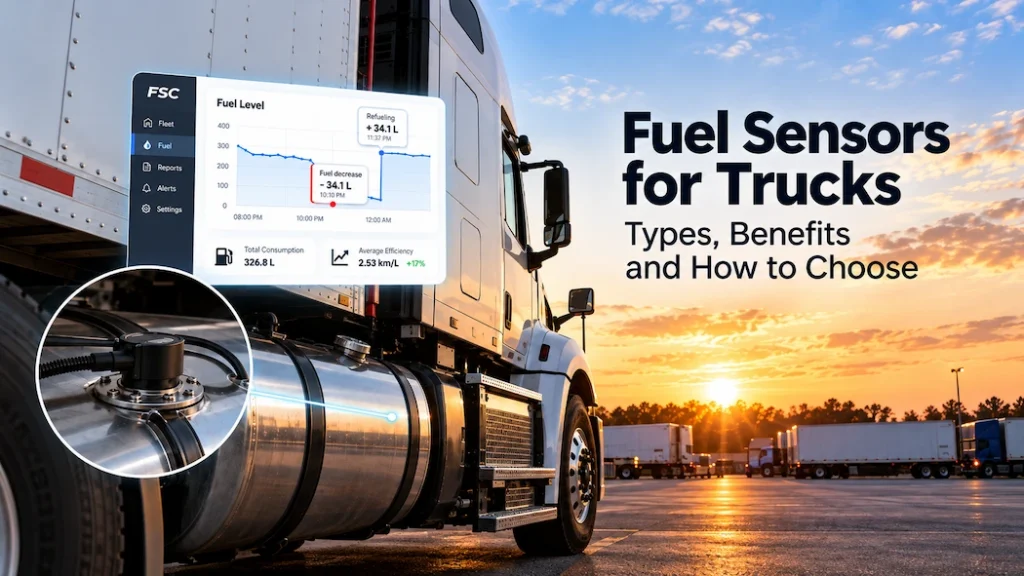
Fuel Sensors for Trucks
Types, Benefits and How to Choose
Managing diesel fuel in a commercial truck fleet requires more than checking dashboard gauges or collecting fuel receipts. Fleet managers need to know how much fuel is available, how much enters each tank during refueling, and whether unexpected changes occur during operation.
Fuel sensors for trucks help measure fuel levels and provide information that supports better consumption monitoring, refueling verification, and fuel loss investigations.
However, not every truck fuel sensor works the same way. Capacitive, ultrasonic, and factory-installed sensors use different measurement technologies, and their suitability depends on the vehicle, tank design, installation requirements, and fleet management objectives.
In this guide, we’ll compare the main types of fuel sensors, explain their benefits for diesel trucks, and help you determine which technology best fits your fleet.
What Is a Fuel Sensor for Trucks?
A fuel sensor for trucks is a device that measures the amount or level of fuel inside a vehicle’s tank. Depending on its technology and configuration, it can provide data about fuel availability and changes associated with consumption, refueling, or fuel withdrawals.
For commercial fleets, a fuel sensor can serve a different purpose from the standard fuel gauge.
A dashboard gauge generally provides an approximate indication of how much fuel remains. A dedicated fuel level sensor connected to a monitoring platform can record measurements over time, making it easier to review how fuel levels change throughout a vehicle’s operation.
This information is particularly useful for:
- Semi trucks and heavy-duty commercial vehicles.
- Delivery trucks and distribution fleets.
- Diesel-powered construction equipment.
- Agricultural vehicles and machinery.
- Commercial fleets with multiple vehicles and fuel tanks.
The main advantage is having a historical record of fuel levels rather than relying entirely on individual gauge readings or refueling transactions.
How Do Fuel Sensors Work in Diesel Trucks?
A diesel fuel level sensor measures changes in the fuel inside a tank and converts those measurements into signals that can be interpreted by an electronic system.
The exact process depends on the type of sensor installed.
For example, some sensors measure changes in electrical capacitance, while others use ultrasonic waves to determine the distance between the sensor and the fuel surface.
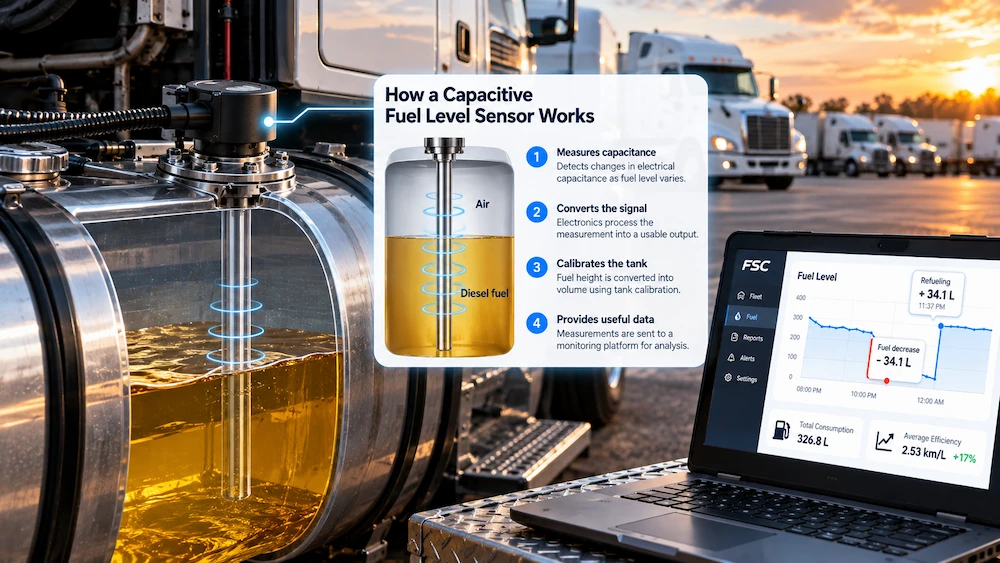
For a fleet monitoring application, the measurement process generally involves four stages:
- Measurement: The sensor detects the fuel level inside the truck’s tank.
- Calibration: The system relates measured levels to estimated fuel volumes using the tank’s dimensions and calibration data.
- Transmission: A compatible device sends measurements to a monitoring application or platform.
- Analysis: Fleet management software organizes the information into fuel histories, reports, or alerts.
Tank calibration is especially important because fuel tanks do not all have the same shape. A small change in fuel height can represent different volumes depending on the tank’s geometry.
Measurements can also be affected by vehicle movement, fuel sloshing, temperature, installation quality, and sensor configuration.
For this reason, selecting a reliable sensor involves evaluating both the measurement technology and the system used to interpret its data.
Types of Fuel Sensors for Commercial Trucks
There are several technologies used to measure fuel levels in vehicles.
Understanding their differences helps fleet managers compare installation requirements, maintenance considerations, and monitoring capabilities.
1. Capacitive Fuel Level Sensors
A capacitive fuel level sensor uses changes in electrical capacitance to measure the height of fuel inside a tank.
Typically, a probe is installed inside the fuel tank. As the fuel level changes, the electrical properties measured by the probe change as well.
The sensor converts these variations into readings that can be used to estimate fuel volume after calibration.
Advantages:
- Continuous fuel level measurement.
- Suitable for many commercial diesel tank configurations.
- Useful for recording refueling events and fuel level changes.
- Can integrate with compatible telematics and monitoring systems.
Limitations:
- Installation generally requires access to the tank interior.
- Calibration is necessary for reliable volume estimates.
- Fuel properties and operating conditions may affect measurements.
- Professional installation may be required.
Capacitive sensors are frequently considered for fleet applications where detailed fuel level monitoring is important.
2. Ultrasonic Fuel Level Sensors
An ultrasonic fuel level sensor uses sound waves to measure the distance to the fuel surface.
In some configurations, the device is mounted externally to the bottom of the tank, allowing measurement without inserting a probe into the fuel.
The sensor sends ultrasonic pulses through the tank wall and calculates the distance using the returning signal.
Advantages:
- Certain models support external installation.
- Can avoid penetrating the fuel tank.
- Useful in applications where an internal probe is unsuitable.
- Provides electronic measurements for compatible monitoring systems.
Limitations:
- Tank material and shape affect compatibility.
- Installation position and surface conditions are important.
- Internal baffles may interfere with measurement.
- Poor acoustic coupling can produce unreliable readings.
An ultrasonic sensor is not automatically more accurate than a capacitive sensor. Actual measurement quality depends on the model, installation, calibration, and operating environment.
3. Float Fuel Level Sensors
Float sensors are common in factory-installed vehicle fuel systems.
They use a floating mechanism that moves as the fuel level rises or falls. This movement produces an electrical signal used by the vehicle’s fuel gauge.
Advantages:
- Commonly included in the original vehicle design.
- Suitable for basic fuel availability indication.
- Usually requires no additional aftermarket installation.
Limitations:
- Dashboard readings are often approximate.
- Not every factory system provides sufficiently detailed data for fuel event analysis.
- Additional integration may be necessary to use the information in fleet management software.
A factory-installed sensor may be adequate for routine vehicle operation but not necessarily for detailed fuel auditing.
4. Fuel Flow Sensors
Unlike fuel level sensors, fuel flow sensors measure fuel passing through a line or system. They can help measure fuel delivery or consumption in certain engine and equipment configurations.
However, measuring fuel flow is not the same as measuring how much fuel remains inside a tank. Some diesel engines also have return fuel lines, which must be considered when calculating actual consumption.
For fleets primarily interested in fuel levels, refueling events, and tank withdrawals, a fuel level sensor may be more appropriate than a flow sensor alone.
Capacitive vs. Ultrasonic Fuel Sensors: Which Is Better?
Neither technology is universally better for every commercial vehicle.
The right choice depends on tank compatibility, required measurement performance, installation conditions, and how the data will be used.
| Feature | Capacitive sensor | Ultrasonic sensor |
|---|---|---|
| Measurement method | Electrical capacitance | Sound waves |
| Typical installation | Probe inside tank | External on some models |
| Tank penetration | Usually required | Not always required |
| Calibration | Required | Required or recommended |
| Main considerations | Fuel properties, probe installation | Tank wall, baffles, acoustic coupling |
| Fleet software integration | Model dependent | Model dependent |
For heavy-duty trucks with compatible diesel tanks, capacitive sensors can be a practical option when continuous level monitoring and detailed tank histories are priorities.
Ultrasonic sensors may be considered where internal installation is undesirable and the tank construction supports reliable acoustic measurement.
Before making a purchase, confirm the manufacturer’s specifications and test the proposed sensor against the actual tank configuration.
How to Choose the Right Fuel Sensor for Your Truck Fleet
Choosing a truck fuel sensor should start with the operational problem you want to solve.
A company trying to verify refueling transactions may have different requirements from a fleet primarily concerned about unexpected fuel withdrawals.
Consider the following factors.
Tank Capacity and Geometry
Confirm the sensor supports the tank’s dimensions, material, and internal configuration.
Large commercial vehicles may have multiple tanks or tanks with irregular shapes. Each installation should be evaluated individually.
Measurement Accuracy and Calibration
Ask how the manufacturer specifies measurement accuracy and under which test conditions. Accuracy figures should not be assumed to apply equally to every installation.
Tank calibration, temperature changes, vehicle inclination, and fuel movement can all influence readings.
Installation and Maintenance
Evaluate whether installation requires drilling, tank access, additional wiring, or specialized technicians. Also consider the equipment’s exposure to vibration, moisture, and other operating conditions.
Data Transmission and Software Compatibility
A sensor is more useful for fleet administration when its measurements can be reviewed over time.
Check whether the proposed system supports:
- Fuel level histories.
- Refueling event records.
- Unusual fuel level changes.
- Reports by vehicle and period.
- Integration with compatible management software.
Fleet Size and Operating Conditions
For a single truck, the requirements may be relatively simple.
For a fleet with dozens of vehicles, the ability to compare fuel information across units can be as important as the sensor itself.
The goal is to select a monitoring solution that remains manageable as fleet operations expand.
Can Fuel Sensors Help Detect Diesel Theft?
Yes. A fuel level sensor can help identify unexpected reductions in the amount of diesel inside a truck’s tank.
For example, a sharp decrease while a truck is parked may indicate a withdrawal that requires investigation.
However, an unexpected fuel level change does not automatically prove fuel theft.
Before reaching a conclusion, fleet managers should review:
- Vehicle activity during the event.
- The date and time of the fuel level change.
- Refueling records.
- Sensor calibration and measurement conditions.
- GPS information, when available.
- Possible maintenance activity or measurement errors.
A Real Fuel Monitoring Case from Fuel Software Control
In a documented commercial fleet operation, Fuel Software Control recorded an unusual diesel fuel level decrease while a vehicle was stationary.
The recorded event showed:
| Event | Recorded information |
|---|---|
| Vehicle status | Stationary |
| First unusual change | 10:10 PM |
| Fuel decrease | 34.1 liters (approximately 9.0 US gallons) |
| Subsequent refueling | 11:37 PM |
| Fuel added | 34.1 liters (approximately 9.0 US gallons) |
The sequence provided a record of the event, including the amount of fuel involved and the time between the decrease and subsequent refueling.
This information can help fleet administrators investigate discrepancies and establish better fuel control procedures.
The same operation also reported an improvement in average fuel efficiency from 2.16 km/L to 2.53 km/L (approximately 5.08 to 5.95 mpg US) after implementation.
That represents an improvement of approximately 17% in the recorded comparison. It should not be interpreted as a guaranteed result for other fleets or proof that the sensor alone caused the change.
Fleet performance depends on routes, vehicle conditions, driver behavior, loads, maintenance, and other operational factors.
How Do Truck Fuel Sensors Connect to Fuel Monitoring Software?
A fuel sensor provides physical measurements from the truck’s tank. Fleet management software organizes those measurements so administrators can review them alongside other operational information.
These are complementary functions.
The sensor measures. The software organizes, analyzes, and helps manage the information.
For example, Fuel Software Control uses fuel sensor measurements to support the review of fuel levels, refueling records, withdrawals, and consumption indicators.
The FSC solution includes a sensor installed in the fuel tank, a transmission device, and access to information through its application and software platform.
With the appropriate configuration, fleet managers can review vehicle-level fuel information and investigate unusual changes.
Learn more about FSC fuel control software and how it helps organize fuel consumption, reports, and operational indicators.
How Much Does a Fuel Sensor for Trucks Cost?
The cost of a truck fuel sensor depends on the technology, manufacturer, installation requirements, and monitoring configuration.
A basic replacement fuel sender for a dashboard gauge may have a different price and purpose from a dedicated commercial fleet monitoring sensor.
For a fleet installation, the total cost should consider:
- The fuel sensor itself.
- Installation labor.
- Tank calibration.
- Transmission or communication equipment.
- Software access, where applicable.
- Ongoing maintenance and support.
The lowest purchase price does not always represent the lowest total operating cost.
An inexpensive device that produces inconsistent measurements or cannot integrate with your fleet’s reporting processes may create additional administrative work.
Before selecting a system, request a quotation based on the number of trucks, tank configuration, and monitoring requirements.
Beyond Fuel Levels: What About Diesel Fuel Quality?
Fuel level monitoring and fuel quality monitoring solve different problems. A fuel level sensor measures how much fuel is available and how that level changes.
A compatible fuel quality sensor monitors properties or changes that may indicate contamination or other abnormal conditions.
For example, the presence of water in diesel fuel can create operational risks that cannot be identified through fuel level measurements alone.
Fuel Software Control also offers optional fuel quality monitoring equipment for applications requiring additional information about diesel conditions.
This capability should be evaluated separately from fuel level measurement because not every fuel sensor includes fuel quality detection.
Explore the FSC fuel sensor solution for trucks to learn about its measurement and optional fuel quality monitoring capabilities.
Frequently Asked Questions About Fuel Sensors for Trucks
What is the best fuel sensor for heavy-duty trucks?
The best sensor depends on tank compatibility, measurement requirements, installation conditions, and software integration. Capacitive sensors are commonly considered for detailed diesel level monitoring, while ultrasonic sensors may suit compatible installations where an internal probe is undesirable.
How accurate are fuel sensors for trucks?
Accuracy varies by sensor technology, manufacturer, calibration, and operating conditions. Ask suppliers for documented accuracy specifications and confirm how measurements perform with your particular fuel tank.
Can a fuel sensor detect fuel theft?
A fuel sensor can record sudden decreases in tank level that may indicate an unauthorized withdrawal. These events should be reviewed against vehicle activity, fuel records, and other evidence before determining the cause.
Can fuel sensors be installed on semi trucks?
Yes. Fuel level sensors can be installed on many semi trucks and other commercial diesel vehicles, provided the selected equipment is compatible with the tank and installation requirements.
Do truck fuel sensors work without GPS?
Some sensors can measure fuel levels without GPS. A compatible transmission and monitoring system is still needed to record or display the information remotely. GPS can provide additional location context when supported and installed.
How much does a fuel sensor for trucks cost?
Pricing depends on the sensor technology, tank configuration, installation, calibration, communication equipment, and software requirements. Fleet managers should compare total implementation costs rather than the sensor price alone.
Can a fuel sensor connect to fleet management software?
Yes, when the sensor and communication equipment support compatible integration. Connected systems can organize fuel measurements into historical records, reports, and operational alerts.
Choosing a Fuel Sensor That Supports Better Fleet Decisions
Fuel sensors for trucks provide valuable information about diesel levels, refueling activity, and unexpected changes inside fuel tanks.
However, effective fuel control requires more than installing a measurement device.
Fleet managers should consider sensor technology, tank compatibility, calibration, data transmission, and the software used to interpret measurements.
A properly configured system can help companies compare fuel records, investigate unusual events, and monitor consumption across multiple vehicles.
Fuel Software Control combines fuel measurement technology with software designed to support fleet fuel monitoring and operational analysis.
If your company wants greater visibility into diesel fuel levels, refueling events, and consumption, explore the FSC fuel sensor solution or contact our team for a consultation.
More articles
See all →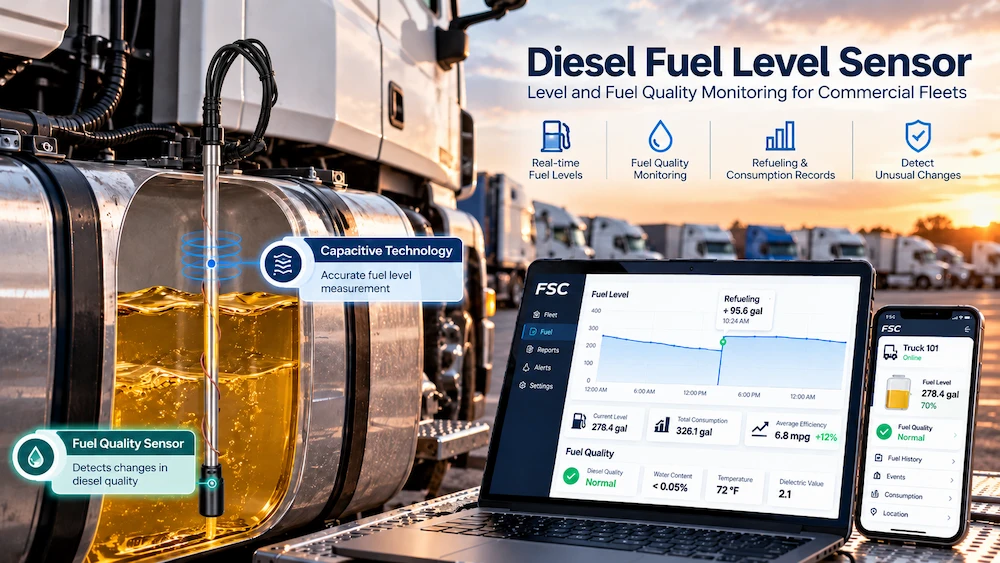
Diesel Fuel Level Sensor
Features, Costs & Monitoring Options A diesel fuel level sensor helps businesses measure how much fuel remains inside a tank and track changes during r…
Capacitive Fuel Level Sensor
How It Works, Benefits & Applications Measuring the amount of diesel inside a truck’s fuel tank is not always as simple as reading the dashboard …