
Capacitive Fuel Level Sensor
How It Works, Benefits & Applications
Measuring the amount of diesel inside a truck’s fuel tank is not always as simple as reading the dashboard fuel gauge. For commercial fleet operators, small discrepancies between recorded refueling volumes and actual tank levels can make it difficult to understand consumption, investigate fuel losses, and maintain accurate records.
A capacitive fuel level sensor provides an electronic method of measuring liquid levels inside a tank. This technology is used in fuel monitoring applications where continuous measurements and detailed fuel level histories are valuable.
But how does capacitance measure fuel? How accurate are these sensors, and what factors should fleet managers consider before installing one?
This guide explains the working principle of capacitive sensors, their advantages and limitations, calibration requirements, and applications in commercial diesel fleets.
What Is a Capacitive Fuel Level Sensor?
A capacitive fuel level sensor is an electronic measuring device that detects changes in the level of liquid inside a tank by measuring variations in electrical capacitance.
Capacitance describes the ability of a system to store electrical charge. In a fuel level sensor, this property changes as the amount of fuel surrounding or separating the sensing electrodes increases or decreases.
The sensor converts those changes into electrical signals that can be interpreted as fuel level measurements.
A capacitive sensor may be installed in diesel fuel tanks, industrial equipment, generators, or other compatible liquid storage systems.
For commercial truck fleets, capacitive technology can provide an alternative to basic dashboard fuel gauges when more detailed tank measurements are required.
It is important to distinguish a capacitive level sensor from a fuel pressure sensor or an engine fuel injection sensor. These devices perform different functions.
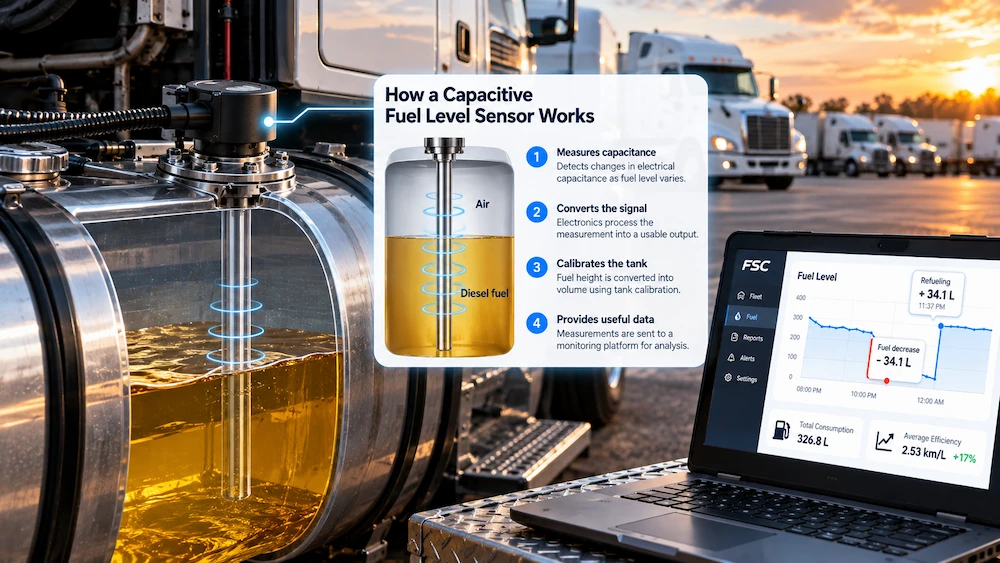
How Does a Capacitive Fuel Level Sensor Work?
A capacitive fuel level sensor working principle is based on differences in the dielectric properties of fuel and air.
A dielectric is a material that affects how an electric field behaves between conductive surfaces.
In a simplified cylindrical capacitive sensor, two conductive electrodes are separated by an insulating gap. The effective capacitance changes as fuel replaces air within the measuring region.
Step 1: The Probe Measures Electrical Capacitance
A capacitive sensing probe is installed inside the tank. As the fuel level rises or falls, the amount of fuel interacting with the measuring electrodes changes.
Because air and diesel have different dielectric properties, these variations affect the measured capacitance.
Step 2: Electronics Convert the Signal
The sensor’s electronic circuitry processes the capacitance measurement and converts it into a usable output. Depending on the sensor model, this may be an analog signal or digital measurement.
The output represents a measured fuel level or another calibrated quantity.
Step 3: Tank Calibration Estimates Fuel Volume
Fuel height and fuel volume are not always directly proportional.
For example, in a horizontal cylindrical diesel tank, the same change in fuel height can represent different amounts of fuel depending on whether the tank is nearly empty, half full, or almost full.
A calibrated relationship between fuel height and tank volume helps the monitoring system estimate the amount of diesel inside the tank.
Step 4: Measurements Are Recorded and Analyzed
When connected to compatible communication equipment, the sensor’s readings can be transmitted to a monitoring application.
Fleet management software can use these measurements to create fuel histories and help administrators review:
- Current or recorded fuel levels.
- Refueling events.
- Unusual decreases in tank level.
- Fuel level changes over time.
- Differences between expected and recorded fuel activity.
The sensor provides the physical measurement, while the software organizes and interprets the information.
Main Components of a Capacitive Fuel Sensor
Although sensor designs differ by manufacturer, a typical capacitive fuel measurement system includes several important components.
Measuring Probe
The probe contains the sensing electrodes responsible for detecting changes in capacitance. Its length and construction must be appropriate for the fuel tank and operating conditions.
Some models support adjustable or cut-to-length probes, while others require specific factory-configured dimensions.
Electronic Measurement Circuit
The electronic circuitry measures changes in capacitance and processes the signal into an output that a compatible system can interpret.
Different sensor models use different processing and communication methods.
Mounting and Sealing Components
The sensor must be securely installed and properly sealed to prevent leaks or contamination. Installation requirements depend on the tank design, sensor construction, and applicable safety procedures.
Communication Equipment
For remote fuel monitoring, a compatible transmitter, telematics device, or data acquisition system may be required.
The sensor itself does not necessarily provide GPS tracking, cellular communication, or fleet management reports. Those capabilities depend on the complete system configuration.
Advantages and Limitations of Capacitive Fuel Level Sensors
Capacitive technology provides several potential advantages for commercial fuel monitoring, but it also has important technical limitations.
| Advantages | Limitations |
|---|---|
| Electronic measurement of changing fuel levels | Requires appropriate tank compatibility |
| Continuous level measurements | Installation may require tank access |
| Suitable for many diesel monitoring applications | Fuel dielectric properties can influence readings |
| Compatible with various monitoring systems | Calibration is necessary for reliable volume estimates |
| Can support refueling and withdrawal analysis | Vehicle movement and fuel sloshing can affect measurements |
Why Capacitive Sensors Are Used in Fleet Monitoring
One important benefit is the ability to capture fuel level changes over time.
A dashboard gauge generally tells a driver approximately how much fuel remains.
A dedicated fuel level monitoring system can provide a historical record of tank measurements that administrators can compare with refueling logs and operating activity.
This can help reduce dependence on manual reporting when reviewing discrepancies in fuel records.
However, the sensor must be installed and configured correctly. Poor calibration or unsuitable operating conditions can undermine the value of the data.
How Accurate Are Capacitive Fuel Level Sensors?
The accuracy of a capacitive fuel level sensor depends on the sensor’s specifications, installation quality, fuel characteristics, and calibration.
It is important to distinguish three concepts:
- Sensor measurement accuracy: How accurately the device measures capacitance or fuel height under specified conditions.
- Volume estimation accuracy: How accurately the measured height is converted into an estimated number of liters or gallons.
- Operational measurement reliability: How consistently the complete system produces useful readings under real vehicle operating conditions.
A sensor may measure height consistently but still produce inaccurate volume estimates if the tank calibration is incorrect.
Factors That Affect Accuracy
Several conditions can influence readings:
- Fuel temperature: Temperature changes can influence fuel properties and measured volume.
- Fuel composition: Differences in dielectric properties may affect certain capacitive measurements.
- Tank geometry: Irregularly shaped tanks require appropriate volume calibration.
- Vehicle inclination: Parking or operating on slopes can change the fuel surface relative to the probe.
- Fuel movement: Acceleration, braking, and vibration can cause temporary level fluctuations.
- Installation quality: Incorrect probe placement or poor electrical connections can introduce errors.
For this reason, buyers should request documented measurement specifications from manufacturers instead of assuming that every capacitive sensor has the same accuracy.
They should also distinguish manufacturer laboratory specifications from performance in an installed vehicle.
How to Install and Calibrate a Capacitive Fuel Level Sensor
Installing a capacitive sensor in a diesel tank requires more than placing a probe inside the container.
The installation should be performed by qualified personnel following the equipment manufacturer’s instructions and appropriate fuel-system safety procedures.
1. Verify Tank Compatibility
Review the tank’s dimensions, material, internal obstacles, and available installation points. The sensing probe should be suitable for the tank’s usable depth and intended operating environment.
2. Determine the Installation Position
Probe placement affects measurement reliability. Installers must account for internal baffles, vehicle inclination, fuel movement, and other equipment inside the tank.
3. Install and Connect the Equipment
Mount the sensor using the specified fittings and sealing components. Electrical connections must follow the sensor and vehicle equipment manufacturer’s requirements.
Work involving fuel tanks requires appropriate precautions to avoid ignition hazards, leaks, and damage to the fuel system.
4. Calibrate the Tank
Calibration associates sensor readings with known fuel levels or volumes.
For irregularly shaped tanks, multiple calibration points may be needed to build an accurate relationship between the measured level and the estimated fuel volume.
For a fleet monitoring system, calibration should also account for the measurement units used in reports.
In the United States, gallons are commonly used for fuel purchases, although some sensors and software systems may internally use liters.
5. Validate the Measurements
After installation, the system should be tested against known or independently verified fuel quantities.
Checking measurements at different tank levels helps identify calibration problems before the data is used for operational decisions.
Calibration procedures vary by device. Always use the sensor manufacturer’s documentation rather than applying a generic procedure to every model.
Applications of Capacitive Fuel Sensors in Diesel Trucks and Commercial Fleets
Capacitive fuel measurement is relevant to several types of diesel-powered operations.
Semi Trucks and Heavy-Duty Vehicles
Heavy-duty trucks often operate over long distances and may carry substantial quantities of diesel.
Recording fuel levels can help fleet managers compare tank measurements with refueling transactions and operating activity.
Some vehicles have multiple fuel tanks, which may require additional sensors and suitable system configuration.
For a broader comparison of technologies, see our guide to fuel sensors for trucks, including capacitive, ultrasonic, and other fuel level measurement methods.
Delivery and Distribution Fleets
Delivery fleets may perform frequent routes, stops, and refueling operations. Historical fuel level records can support administrative reviews and help identify unusual changes that require investigation.
Construction and Agricultural Equipment
Excavators, tractors, generators, and similar equipment may consume fuel while remaining stationary. In these applications, distance traveled is not always a useful measure of fuel consumption.
Direct tank level monitoring can provide additional information for fuel administration.
Stationary Diesel Tanks
Capacitive sensors may also be suitable for compatible stationary fuel storage tanks.
Tank design, operating conditions, fuel characteristics, and any applicable safety requirements must be considered when selecting the equipment.
Capacitive vs. Ultrasonic Fuel Level Sensors
Both capacitive and ultrasonic sensors are used to measure liquid levels, but they operate according to different physical principles.
A capacitive sensor detects variations in electrical capacitance, while an ultrasonic sensor determines distance using acoustic signals.
| Feature | Capacitive sensor | Ultrasonic sensor |
|---|---|---|
| Measurement principle | Electrical capacitance | Sound waves |
| Typical configuration | Probe inside the tank | External or internal, depending on model |
| Tank penetration | Usually required | Not required for some external models |
| Calibration | Required | Required or recommended |
| Important factors | Fuel dielectric properties, probe installation | Tank material, acoustic coupling, internal obstacles |
| Main fleet application | Fuel level monitoring | Fuel level monitoring |
Neither technology is universally more accurate or appropriate.
The best choice depends on the tank, installation constraints, fuel characteristics, and performance of the specific sensor.
For fleets evaluating multiple technologies, a comparison should focus on verified operating requirements rather than a general claim that one sensor type is always superior.
Can a Capacitive Fuel Sensor Help Detect Diesel Theft?
A capacitive fuel sensor can provide measurements that help identify unusual reductions in diesel fuel levels.
For example, a large level decrease while a vehicle is parked may warrant investigation. However, a sensor reading alone cannot establish that a theft occurred.
The event should be evaluated alongside:
- Vehicle movement or operating status.
- Date and time of the measurement.
- Refueling and maintenance records.
- Sensor calibration.
- Possible fuel transfers.
- GPS or other telematics data, when available.
Changes caused by fuel movement, sensor issues, or legitimate operating activities must be ruled out before drawing conclusions.
The operational value of fuel measurement comes from creating records that help administrators investigate discrepancies more systematically.
How Capacitive Fuel Sensors Work with Fuel Monitoring Software
A fuel sensor measures changes inside the tank, but fleet administrators also need a practical way to review the data.
When compatible sensors are connected to fleet monitoring systems, their readings can support historical reports and comparisons between units.
For example, Fuel Software Control (FSC) combines tank measurement equipment with a transmission device and software platform.
The measurement device records variations inside the fuel tank, while the connected system allows administrators to review fuel levels, refueling events, withdrawals, and operational indicators.
This separation is important:
- The sensor measures fuel level changes.
- The transmission equipment communicates the measurements.
- The software organizes and analyzes the recorded information.
Learn how FSC fuel control software helps fleet managers monitor and analyze fuel information across their vehicles.
Fuel Level Measurement vs. Fuel Quality Monitoring
Fuel level and fuel quality are separate measurements. A capacitive level sensor is designed to measure liquid level. It should not automatically be assumed to detect water contamination, adulteration, or changes in diesel quality.
Fuel quality monitoring requires equipment specifically designed for those parameters. FSC also offers optional fuel quality monitoring solutions that complement its fuel level measurement system.
Explore the FSC fuel sensor solution to learn more about the available monitoring capabilities.
Frequently Asked Questions About Capacitive Fuel Level Sensors
What is a capacitive fuel level sensor?
A capacitive fuel level sensor is an electronic device that measures liquid level by detecting changes in electrical capacitance as fuel rises or falls around its sensing electrodes.
How does a capacitive fuel level sensor work?
It measures electrical changes caused by the different dielectric properties of fuel and air. The sensor electronics interpret these variations as fuel level measurements, which can be converted into volume estimates after tank calibration.
How accurate are capacitive fuel level sensors?
Accuracy varies by sensor model, calibration quality, fuel characteristics, and operating conditions. Manufacturer specifications should be verified against the intended tank installation.
Can capacitive fuel sensors measure diesel?
Yes. Capacitive fuel level sensors can be designed for diesel applications. Buyers should verify the selected sensor’s compatibility with the specific fuel and operating environment.
Do capacitive fuel level sensors require calibration?
Yes. Proper calibration is important when converting measured fuel height into estimated volume, particularly in tanks with irregular geometries.
What is the difference between capacitive and ultrasonic fuel sensors?
Capacitive sensors measure changes in electrical capacitance, while ultrasonic sensors use acoustic signals to measure distance to the liquid surface. Each technology has different installation requirements and operating considerations.
Can a capacitive fuel level sensor connect to fleet management software?
Yes, provided the sensor, communication equipment, and software support compatible integration. A connected system can record measurements and help fleet managers analyze changes in fuel levels.
Choosing a Capacitive Fuel Level Sensor for Your Operation
A capacitive fuel level sensor can provide valuable measurements for diesel tank monitoring, particularly when fleet managers need information beyond a basic dashboard fuel gauge.
Its effectiveness depends on selecting appropriate equipment, calibrating the tank correctly, and ensuring that the measurement system suits the vehicle’s operating conditions.
For commercial fleets, connecting compatible fuel sensors to monitoring software adds the ability to review measurement histories, compare refueling records, and investigate unusual fuel level changes.
Fuel Software Control combines fuel measurement equipment with a software platform designed to support fuel monitoring and operational analysis.
If your company is evaluating fuel level monitoring solutions for trucks, equipment, or stationary tanks, explore the FSC fuel sensor solution or contact the FSC team to discuss your requirements.
More articles
See all →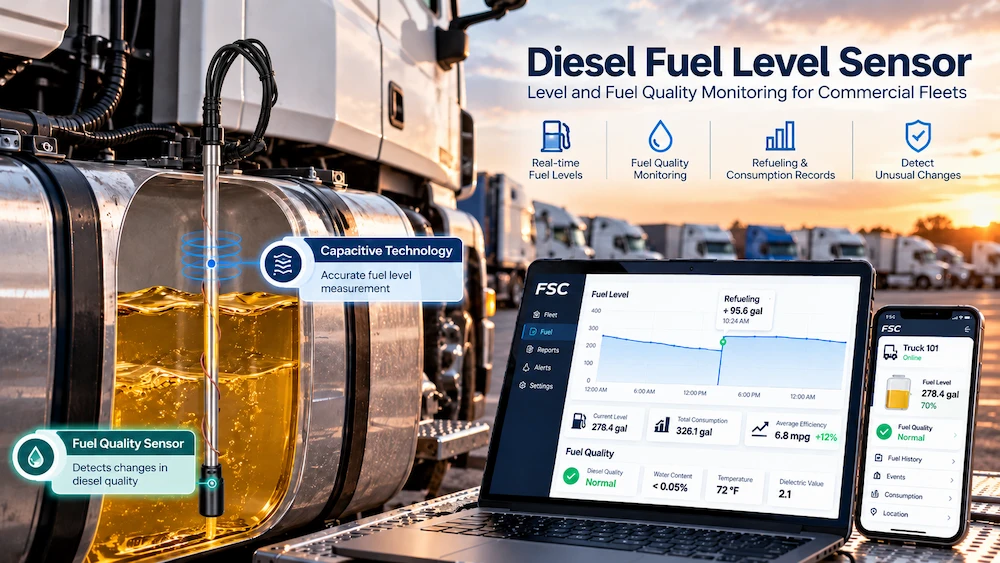
Diesel Fuel Level Sensor
Features, Costs & Monitoring Options A diesel fuel level sensor helps businesses measure how much fuel remains inside a tank and track changes during r…
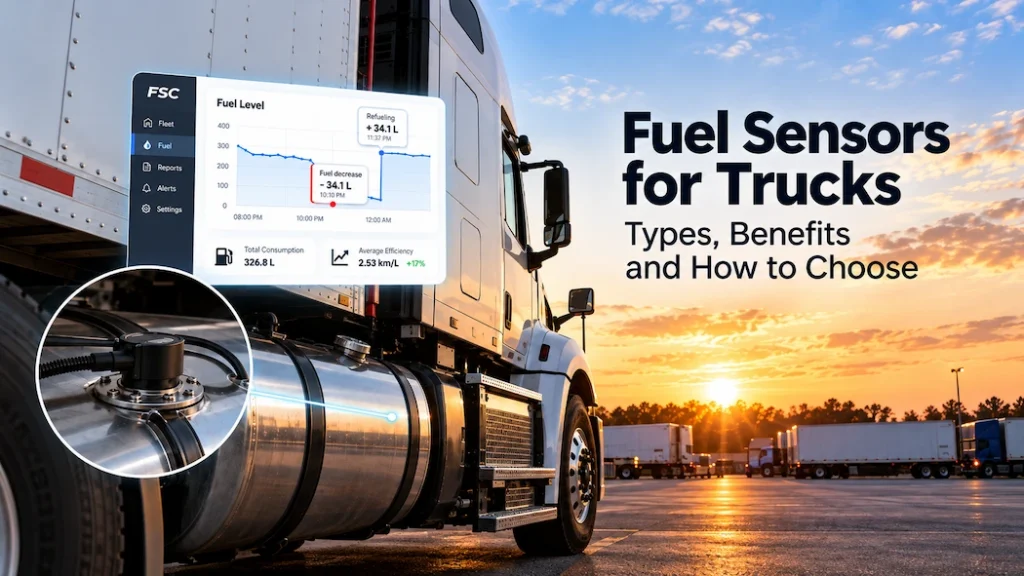
Fuel Sensors for Trucks
Types, Benefits and How to Choose Managing diesel fuel in a commercial truck fleet requires more than checking dashboard gauges or collecting fuel receipts…