
Diesel Fuel Level Sensor
Features, Costs & Monitoring Options
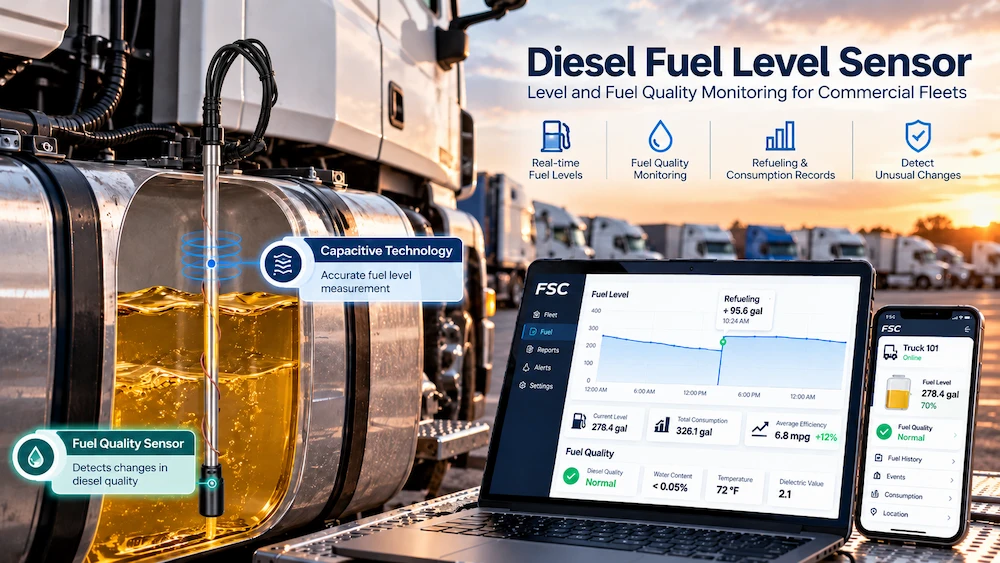
A diesel fuel level sensor helps businesses measure how much fuel remains inside a tank and track changes during refueling, vehicle operation, or fuel withdrawals.
For transportation companies and businesses operating diesel-powered equipment, accurate fuel information is important for controlling expenses, verifying refueling records, and identifying unusual changes in fuel levels.
However, not every diesel fuel sensor is designed for the same application.
Some sensors are simple replacement components for dashboard fuel gauges. Others are specifically designed for commercial fuel monitoring and can connect to software platforms that record fuel measurements over time.
If your company is evaluating diesel fuel level sensors, this guide explains what to look for, how different technologies compare, what affects installation costs, and when an integrated sensor and software solution may be more appropriate.
What Is a Diesel Fuel Level Sensor?
A diesel fuel level sensor is a measurement device designed to detect the amount or height of diesel inside a fuel tank.
Depending on the technology, a sensor may use electrical capacitance, ultrasonic waves, or a mechanical float to measure changes in liquid level.
These measurements can serve different purposes.
A standard fuel sending unit typically supplies information to a vehicle’s dashboard gauge, helping the driver estimate how much fuel remains.
A dedicated diesel fuel monitoring sensor may provide measurements to external equipment that records tank levels and communicates them to a monitoring platform.
The main difference is the intended application.
For example, a replacement sending unit may be sufficient to repair a malfunctioning dashboard gauge. However, a transportation company seeking historical fuel records, refueling verification, and information about unusual tank level changes may need additional monitoring capabilities.
Why Diesel Fuel Level Monitoring Matters for Commercial Operations
Diesel expenses can represent a significant operating cost for companies that rely on trucks, heavy equipment, and generators.
Without reliable measurements, administrators may struggle to explain discrepancies between fuel purchases and recorded consumption.
A properly configured fuel monitoring system can help answer important questions:
- How much diesel remains in each tank?
- How much fuel was added during refueling?
- Did an unusual fuel level decrease occur?
- Are reported fuel transactions consistent with tank measurements?
- How did fuel levels change during a specific operating period?
These questions are particularly relevant for businesses managing multiple vehicles or equipment units.
Refueling Verification
Fuel purchase receipts show how much diesel was billed, but they do not independently measure how much fuel entered the tank.
A calibrated sensor can provide additional information about the change in tank level during refueling.
Measurement tolerances, fuel movement, and operating conditions must still be considered when comparing readings.
Monitoring Unexpected Fuel Losses
A sudden reduction in tank level may indicate a fuel withdrawal or another event requiring investigation.
Reviewing the time, magnitude, and operating circumstances of the event can help administrators determine whether further action is necessary.
Improving Fuel Records
Historical sensor measurements can complement manual refueling logs, vehicle mileage, and consumption reports.
The objective is not simply to collect more data, but to make fuel information easier to review and compare.
Types of Diesel Fuel Level Sensors
Several measurement technologies are available for diesel tanks.
The best option depends on the tank’s construction, operating conditions, measurement requirements, and how the sensor data will be used.
| Sensor type | Measurement method | Typical consideration |
|---|---|---|
| Capacitive sensor | Changes in electrical capacitance | Detailed level monitoring with tank calibration |
| Ultrasonic sensor | Acoustic distance measurement | External installation possible on compatible tanks |
| Float sensor | Mechanical float position | Conventional dashboard fuel indication |
| Hydrostatic sensor | Liquid pressure | Selected stationary and industrial tank applications |
Capacitive Diesel Fuel Level Sensors
A capacitive sensor measures changes in electrical capacitance as diesel rises or falls along a sensing probe.
These sensors are commonly considered for commercial tank monitoring applications because they can provide electronic fuel level measurements.
However, installation, fuel properties, tank calibration, and operating conditions affect measurement performance.
For companies evaluating this technology, understanding calibration and sensor compatibility is essential.
Ultrasonic Diesel Fuel Level Sensors
Ultrasonic sensors measure the distance to the fuel surface using sound waves. Some models can be installed externally, while others require a different mounting arrangement.
Tank material, internal baffles, acoustic coupling, and installation position may affect reliability.
Float Fuel Level Sensors
Float sensors are common in factory-installed vehicle fuel systems.
They are widely used to supply information to dashboard gauges. Although they may be sufficient for routine fuel indication, not every factory-installed sensor provides the data resolution or integration capabilities required for detailed fleet monitoring.
Hydrostatic Fuel Level Sensors
Hydrostatic sensors estimate liquid level from pressure.
They can be suitable for certain stationary diesel storage applications, provided the equipment is compatible with the fuel and tank configuration.
Their suitability for mobile vehicles must be assessed according to the specific installation and operating requirements.
How to Choose a Diesel Fuel Level Sensor for Trucks
Before purchasing a diesel fuel sensor, companies should evaluate how the equipment will be used.
A sensor selected solely because of its low purchase price may not meet the requirements of a commercial fuel monitoring operation.
1. Confirm Tank Compatibility
Check the capacity, dimensions, shape, construction, and available installation points of the diesel tank.
For semi trucks with multiple tanks, confirm how many sensors are required and whether the monitoring equipment can accommodate that configuration.
2. Evaluate Measurement Accuracy
Ask the supplier for documented accuracy specifications. Measurement performance depends on more than the sensor itself. Tank calibration, installation quality, fuel characteristics, and vehicle movement can all influence readings.
3. Review Installation Requirements
Determine whether the sensor requires internal tank access, drilling, wiring, sealing components, or specialized installation.
Fuel tank work should be performed by qualified personnel using appropriate safety procedures.
4. Verify Software Compatibility
If the objective is fuel management rather than simple level indication, confirm that the sensor can communicate with a compatible monitoring platform.
Useful capabilities may include fuel level histories, refueling records, unusual level change events, and reports by vehicle.
5. Consider the Entire Fleet
A system that works adequately for one truck may become difficult to manage across multiple vehicles without centralized reporting.
Companies should consider how the solution handles multiple tanks, vehicles, operating periods, and administrators.
For businesses seeking a commercial monitoring solution, explore the Fuel Software Control diesel fuel sensor system and its integration options.
Diesel Fuel Level Sensor vs. Diesel Fuel Monitoring System
A diesel fuel level sensor and a diesel fuel monitoring system are related, but they are not the same product.
A sensor measures fuel levels. A monitoring system collects, organizes, and presents measurements for analysis.
A complete configuration may involve several components.
| Component | Primary function |
|---|---|
| Diesel fuel level sensor | Measures tank level changes |
| Transmission device | Communicates sensor measurements |
| Software platform | Organizes records, reports and analysis |
| GPS or telematics equipment | Adds location or vehicle activity context when integrated |
A standalone sensor may be sufficient when a company only needs a local level reading.
However, when administrators need to investigate refueling discrepancies or review multiple vehicles, software integration becomes more important.
What Should a Diesel Fuel Tank Monitoring System Include?
When comparing fuel monitoring solutions, businesses should look beyond the sensor specifications. The goal is to obtain information that supports operational decisions.
Fuel Level History
The system should allow administrators to review recorded tank levels over time. This helps establish when changes occurred and how they relate to operating activity.
Refueling Records
A monitoring platform should support the review of refueling events and the amounts recorded by the system.
Administrators can compare these measurements against purchase records while accounting for sensor tolerances and calibration.
Unusual Fuel Level Changes
Significant decreases in tank level may require investigation, particularly when they occur during periods without expected fuel consumption.
An alert or recorded event is an indication for review, not conclusive evidence of theft.
Consumption and Operational Reports
Fuel measurements become more useful when they can be analyzed by vehicle and period.
Where mileage or operating information is available, administrators may also review fuel efficiency and consumption trends.
Reporting Across Multiple Vehicles
Commercial operations often need to compare vehicles instead of reviewing every tank independently. A centralized platform can reduce the administrative effort required to consolidate separate fuel records.
How Much Does a Diesel Fuel Level Sensor Cost?
The cost of a diesel fuel level sensor depends on the measurement technology, manufacturer, sensor specifications, tank compatibility, and installation requirements.
It is important to distinguish between a basic fuel sending unit and a complete commercial monitoring solution. A replacement sensor for an existing dashboard gauge may have a lower initial cost but does not necessarily provide remote monitoring or historical reporting.
For commercial operations, a complete quotation should account for:
- Sensor equipment.
- Mounting components and installation.
- Tank calibration.
- Communication devices.
- Software access and applicable subscription fees.
- Maintenance and technical support.
Rather than comparing equipment prices alone, buyers should evaluate total implementation costs.
For example, a system that requires additional installation work may offer capabilities that a basic fuel sending unit does not provide.
Similarly, software access may increase operating costs while adding reporting and monitoring functions valuable to the company.
The right choice depends on the intended use, not simply the lowest listed price.
Why Combine Diesel Fuel Sensors with Fuel Monitoring Software?
For businesses operating multiple diesel vehicles, sensor readings can become significantly more useful when organized into a monitoring platform.
A level measurement shows the estimated amount of fuel inside a tank at a specific moment.
A historical record can help explain how the level changed during a shift, route, or operating period.
Fuel Software Control combines fuel measurement equipment with software designed to support fuel monitoring and operational analysis. Its integrated approach connects measurement equipment with a communication device and a software platform.
Depending on the configured solution, administrators can review information such as:
- Fuel level measurements.
- Refueling and withdrawal records.
- Historical fuel changes.
- Consumption indicators.
- Reports organized by vehicle.
The purpose is to help companies investigate discrepancies and gain better visibility into fuel-related operations.
Explore FSC fuel monitoring software to learn how recorded measurements can support fuel control and reporting.
Diesel Fuel Monitoring as Part of Fleet Management
Fuel monitoring is one important part of operating a commercial fleet, but it does not cover every operational requirement.
Fleet administrators may also need to track tire conditions, maintenance activity, vehicle information, and operating expenses.
For companies evaluating broader technology integration, Gasmonsoft fleet management solutions bring together software, telematics, and monitoring technologies for fuel, tires, and operational data.
These capabilities complement specialized diesel measurement systems rather than replacing them.
Frequently Asked Questions About Diesel Fuel Level Sensors
What is the best diesel fuel level sensor for trucks?
The best option depends on tank compatibility, measurement requirements, installation conditions, and the intended monitoring application. Capacitive and ultrasonic sensors are both used in diesel monitoring, but their suitability must be evaluated for the specific vehicle.
Can a diesel fuel level sensor detect fuel theft?
A sensor can record unexpected decreases in tank level that may indicate a possible withdrawal. However, a fuel level change alone does not prove theft. Vehicle activity, calibration, operating conditions, and other records should be reviewed.
How much does a diesel fuel level sensor cost?
Costs vary by sensor technology, manufacturer, tank configuration, and installation requirements. Commercial monitoring systems may also require communication equipment, calibration, and software access.
Can diesel fuel sensors work with dual fuel tanks?
Yes, compatible monitoring systems can support vehicles with more than one diesel tank. The number of sensors and communication requirements depend on the vehicle configuration and the equipment selected.
Can I monitor diesel fuel levels remotely?
Yes. A diesel fuel level sensor can support remote monitoring when connected to compatible transmission equipment and a software platform. Remote availability depends on communication coverage, system configuration, and data transmission intervals.
What is the difference between a fuel level sensor and a fuel monitoring system?
A fuel level sensor measures changes in tank level. A monitoring system collects and organizes measurements, allowing administrators to review histories, reports, and fuel-related events.
Is a diesel fuel monitoring system worth it for a commercial fleet?
It may be valuable for businesses that need better fuel records, refueling verification, or information about unexpected fuel level changes. The financial benefit depends on fleet size, fuel spending, implementation costs, and how effectively the information is used.
Choosing the Right Diesel Fuel Monitoring Solution
A diesel fuel level sensor can help businesses obtain better information about the fuel inside their tanks.
However, equipment selection should consider more than the type of sensor.
Tank compatibility, calibration, installation, communication requirements, and reporting capabilities all influence the usefulness of the solution.
For commercial operations, combining fuel measurements with monitoring software can help administrators review refueling activity, investigate unusual changes, and organize fuel information across multiple vehicles.
Fuel Software Control provides fuel measurement and monitoring solutions designed to support better visibility into diesel consumption and tank activity.
If your company is evaluating sensors and monitoring software, review the FSC diesel fuel sensor solution or contact the Fuel Software Control team to discuss your requirements.
More articles
See all →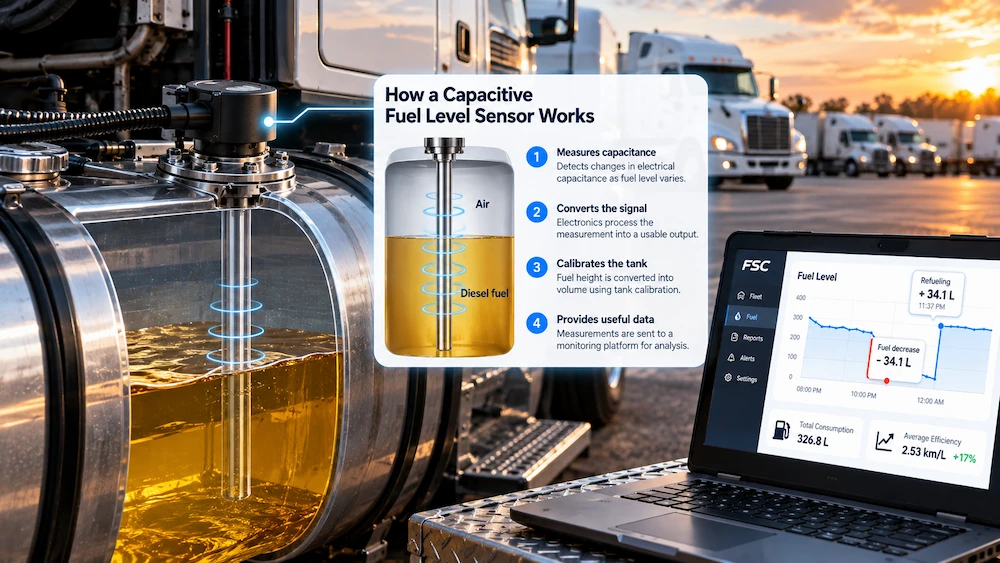
Capacitive Fuel Level Sensor
How It Works, Benefits & Applications Measuring the amount of diesel inside a truck’s fuel tank is not always as simple as reading the dashboard …

Fuel Sensors for Trucks
Types, Benefits and How to Choose Managing diesel fuel in a commercial truck fleet requires more than checking dashboard gauges or collecting fuel receipts…